ABOUT Jordan Quill
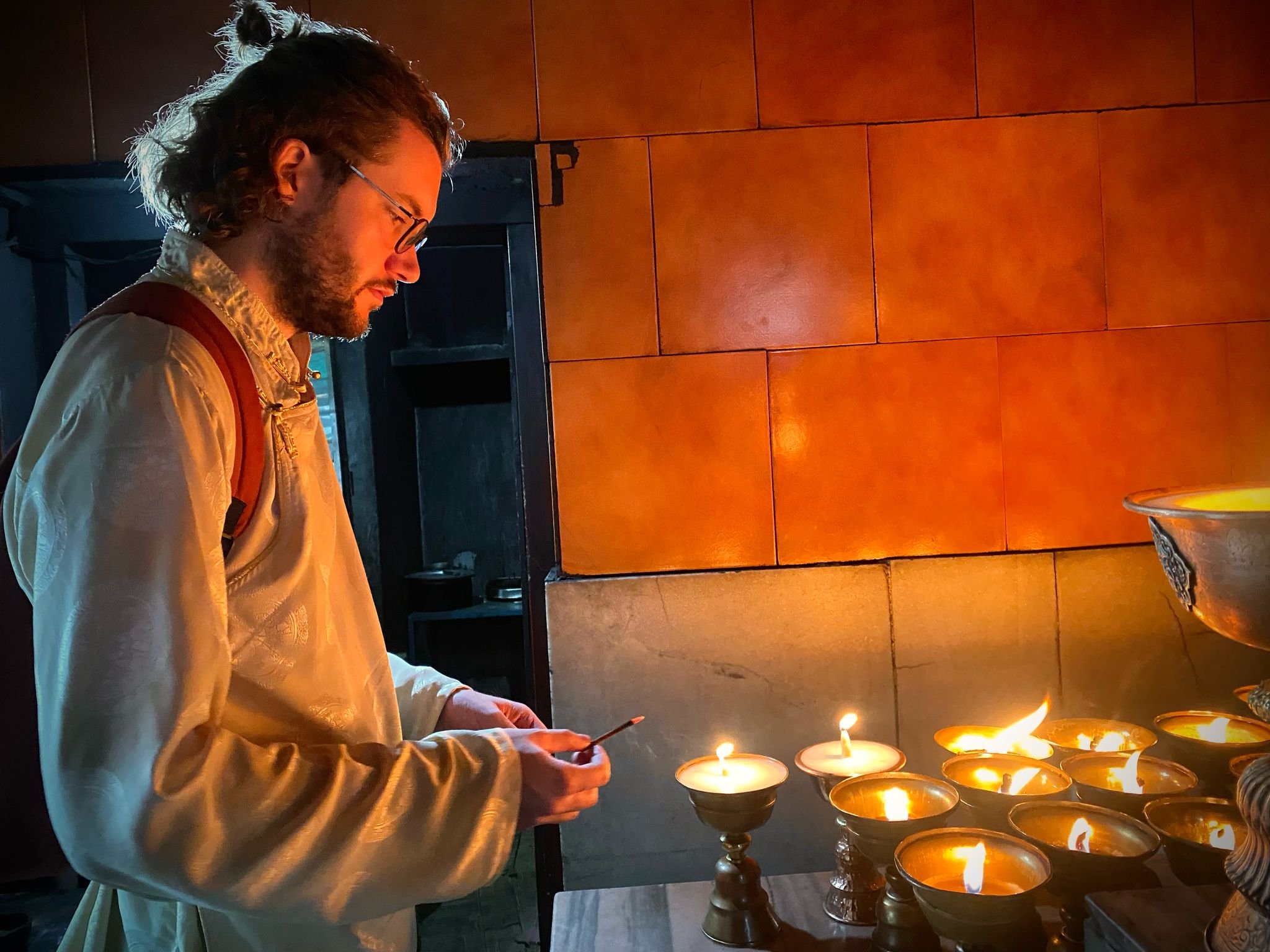
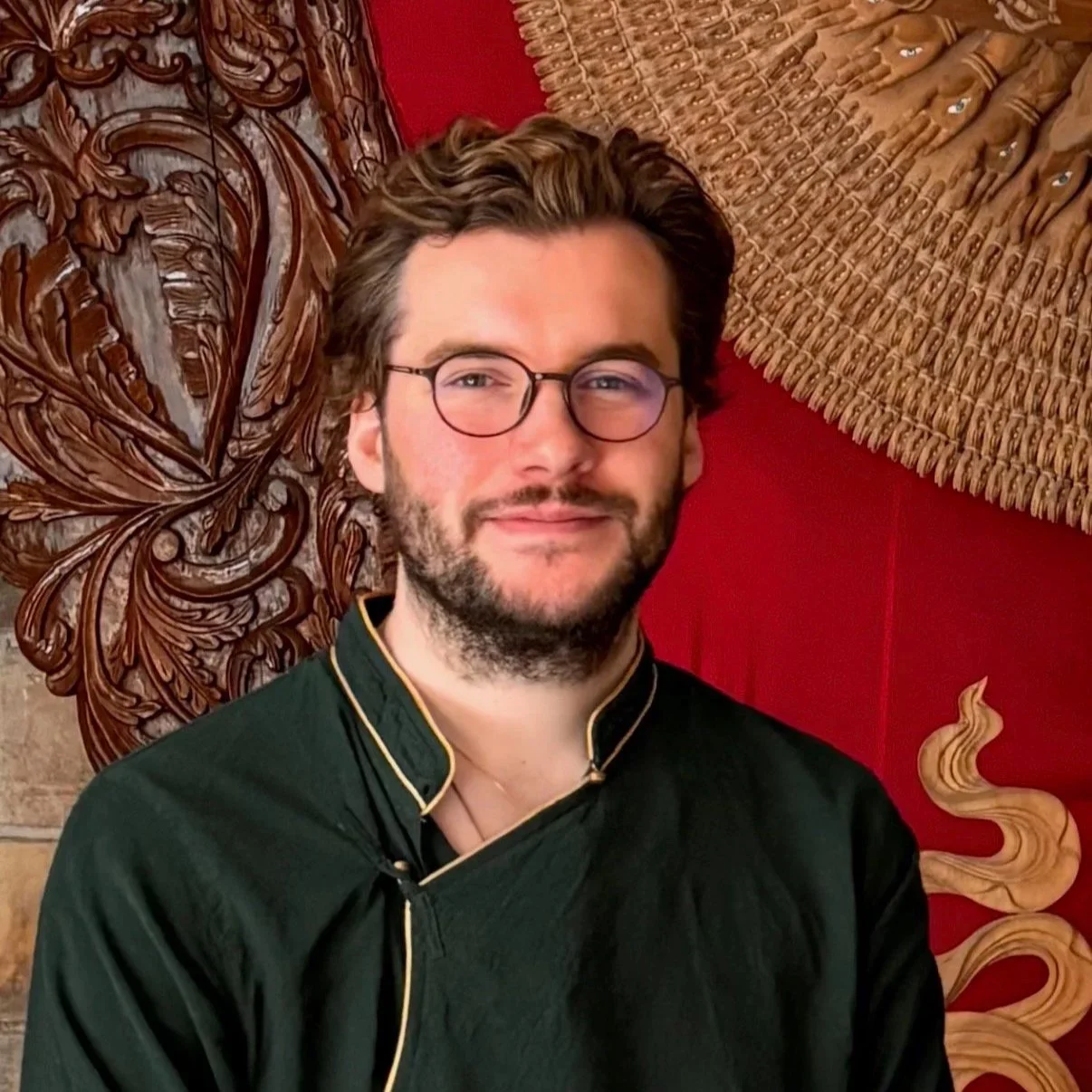
Dr Jordan Quill is a British art historian of South, Central and Inner Asia. His research focusses on textiles, with a particular interest in Tibet, India, and the Himalayas. After receiving his BA in Art History from the Courtauld Institute of Art, specialising in Central Asian architecture and textiles, he completed an MPhil in Tibetan and Himalayan Studies at the University of Oxford. He completed his PhD on Indian palace textiles at The Courtauld in 2026, and has travelled extensively in India, Nepal, and Central Asia.
Jordan has published numerous academic articles, a children’s book, and is now working on his first major book on Indian textiles and Tibetan art. He has worked with numerous museum collections of Tibetan art, including at the British Museum, V&A, and the Tibet Museum in Dharamshala.
From each page you can get in touch to inquire about studying with, travelling with, or working with Jordan, as well as access and purchase a range of hand-painted, personally curated traditional Himalayan thangka paintings.
For upcoming tours and short courses, please see the links at the top of the page.
Please join Jordan’s mailing list below to receive personal updates on future courses, tours and other news!


Education
2021-2026: Courtauld Institute of Art, University of London,
PhD in History of Art
Thesis title: Clothing the Palace: Indo-Persianate Textile Experience in the Courts of Northern India.
2019-2021: The University of Oxford, The Queen’s College/Faculty of Asian and Middle Eastern Studies,
MPhil in Tibetan and Himalayan Studies: Merit with Distinction in thesis.
Thesis title: An Interwoven World: Sensory Experiences of Textiles in the Alchi Sumtsek.
2014-2017: Courtauld Institute of Art, University of London,
BA (hons) History of Art: First
Dissertation title: From Fabric to Ceramic: Symbolic Experiences of Trellis Tents in the Khanate of Khiva.
My BA dissertation won the award ‘The Courtauld Prize – Outstanding BA History of Art Year Three Essay’.
Employment
2025-2026: The British Museum, London. Project Curator: Tibet:
I undertook a fixed-term contract as Project Curator: Tibet, to document and research The British Museum’s collection of Tibetan (mainly Buddhist) objects acquired by the Museum between 1903 and 1959, to determine the provenance of those associated with the 1903-04 British Military Invasion of Tibet led by Francis Younghusband. This role utilised my skills with the Tibetan language, including me adding the Tibetan language and script to the museum’s searchable Collections Online for the first time, widening participation to Tibetan communities. It also drew upon my research and knowledge of Tibetan arts, especially thangka painting, metalwork, and textiles, and my ability to perform technical analysis on these objects. During this time, I gave a lunchtime lecture on my work, led a workshop with the objects, and determined solid provenance for over 350 artefacts through archive research, the results of which is now freely accessible on the website within the object records. Beyond this core work, I also responded to public enquiries, offered suggestions for display, attended an international Tibetan museum collections workshop, and worked as part of the wider South Asia and Asia department.
2025- present: The Courtauld Institute of Art Short Courses, London. Course Leader, ‘On the Roof of the World: An Introduction to the Art and Architecture of Tibet and the Himalayas’:
I designed and taught a Summer School Short Course on Tibetan and Himalayan art and architecture at The Courtauld in the summer of 2025, which received very positive feedback and is due to run again in the 2026 Summer School owing to its success. This work enabled me to share my enthusiasm for the subject with very interested students, many of whom have travelled in the region in the past. Generous feedback from the students and genuine engagement and excitement both during and beyond the course made this a genuinely meaningful experience, and I am incredibly thankful that I have already been asked back for the next season. This course involved both the delivery of interactive lectures, which I wrote, and visits to museums, galleries, and a temple in London, as well as handling sessions at SOAS and The British Museum, which I organised.
2025: The Tibet Museum, Central Tibetan Administration, Gangchen Kyishong, Dharamshala, Himachal Pradesh, India, AHRC Doctoral Work Placement (Internship):
I organised and undertook a three-month AHRC doctoral work placement at The Tibet Museum in the Central Tibetan Administration, Dharamshala, India. There, I led a fieldwork project using my past skills working with antique textiles to properly store, conserve and look after the museum's growing collection of Tibetan textiles, largely brought from Tibet by refugees during their escape. This involved upgrading the current documentation of the majority of their significant textiles collections to include information previously missing such as material analysis, dating, and background research. It involved working within the Tibet Museum team, and collaborating on projects beyond my own, including setting up and explaining temporary travelling exhibitions at the Tibetan Children's Village School in upper McLeodganj. The work with the textiles collections was a significant change from the pre-arranged project on Tibetan dress in exile. This change reflected the museum's priorities and the urgency of caring for this collection, and was suggested by me to maximise the impact I could have while at the museum. It enabled me to utilise my existing skills to care for their collection and significantly update their documentation of the objects to inform future preventative conservation work. l wrote an article on this work to be published in their journal. I also supervised and independently taught two undergraduate student interns from the Dalai Lama Institute for Higher Education the processes of preventative conservation of textiles for a number of weeks. Should the project be approved by the Central Tibetan Administration, I have also been asked to write a catalogue of the Tibetan textiles and dress collection. While here, to improve my working Tibetan, I enrolled in the Intermediate Tibetan Language course at the nearby Library of Tibetan Works and Archives and was also involved in the wider context of working for the Central Tibetan Administration. For this role I operated in both English and Tibetan language.
2024-5: The Victoria and Albert Museum, London, AHRC Doctoral Work Placement:
I arranged and completed a three-month AHRC doctoral work placement at the Victoria and Albert Museum within the Asia department. There, I was responsible for the completion of my own project, to create an accessible archive for the curation of the Tibetan and Himalayan collections at the museum from the archive of John Clarke, the late curator of Himalayan and South- East Asian art. This included extensive material related to the gallery displays in the museum of Buddhist (Tibetan, Himalayan, and South Asian) art. Simultaneously, and being based within the India department, I was exposed to the inner workings of the current 'Great Mughals' temporary exhibition and led a number of informal tours. I was also actively involved in the department team more widely, including undertaking investigative work into possible new displays with the curator of South East Asia. I also assisted with the logistics of an international conference on Indian textiles, and with object study sessions of South Asian art. The arranging and successful completion of these two doctoral placements demonstrates my ability to collaborate with museum institutions both nationally and internationally. It does so by showing my willingness to negotiate with senior members of museum staff, to meet with them in formal settings, and to establish meaningful project work that enabled me to get valuable museum experience at the same time as doing something to benefit the institutions involved. This was all done at the same time as completing complex and extensive groups of paperwork, in particular for my international placement. These, coupled with my previous employment (below), have enabled me to develop a good understanding of museum best practice, directly related to collections from the same regions as the advertised role, which I would be keen to share at the British Museum. In both placements, both projects were completed on time and did not exceed any budget or limitations set by the institutions. These placements also demonstrate my ability to successfully work with national and international colleagues within the museum sector and beyond.
2022: Courtauld Institute of Art, University of London:
Research Assistant.
2018-2023: Joss Graham Gallery, London:
Weekend Manager, Gallery Assistant, Social Media Lead, Primary Curator and Display Coordinator, working with antique textiles and works of art from India, Pakistan, Tibet, Mongolia, the Himalayas, Japan, Central, South and Southeast Asia. I led a number of classes for visiting students, including groups from SOAS, and managed the gallery’s social media for a number of years. I participated in public events and private views, hanging new displays of antique works of art, dealing with curators, lecturers and collectors. I have experience in working with major interior design companies, and with bespoke-made products. I also have experience with carrying out research for dating and identifying numerous textiles and other artefacts.
2017-2018: Turkmen Gallery, London:
Assistant Manager,Turkmen and Central Asian Antique Textiles and Works of Art.
2017-2018: Turquoise Mountain, London (remote):
Research Volunteer for the Afghanistan branch of Turquoise Mountain, researching the historic nineteenth-century centre of Kabul.
2014-2017: Courtauld Institute of Art, Book Library, London:
Assistant Student Librarian.
Volunteer Work
2022-present: English Language Teaching, Dharamshala, India: I regularly volunteer to teach English informally to Tibetan refugees in various contexts in the Tibetan settlement of McLeodganj, Dharamshala, Himachal Pradesh, India.
2022-present: Himalayan Tribal Buddhist Welfare Society, (हिमालय बौद्ध जनजातीय कल्याण सभा / ཧི་མཱ་ལ་ཡའི་ནང་པའི་རིགས་རྒྱུད་བདེ་དོན་ཚོགས་པ།), Kinnaur, Himachal Pradesh, India: Consultant volunteer translator (Tibetan and Hindi into English) and secretary (including several successful funding applications).
2021: LopLao སློབ་སླའོ། (Easy Tibetan),London (remote): Trustee (secretary) for LopLao, a Tibetan language school based in the UK.
2015-2017: Courtauld Institute of Art Annual Book Sale, London.
Teaching, Lectures, other Academic Work
2026: Course Leader, ‘On the Roof of the World: An Introduction to the Art and Architecture of Tibet and the Himalayas’, Summer School Short Course, Courtauld Institute of Art.
2026: Lunchtime Lecture, ‘Tibet, Younghusband, and The British Museum during the age of the Thirteenth Dalai Lama’, The British Museum, London.
2025: Public Lecture, ‘A Taste for the Exotic: The Textiles of Tibet and the Himalayas since the Age of the Tibetan Empire’, The Oriental Rug and Textile Society, London.
2025: Course Leader, ‘On the Roof of the World: An Introduction to the Art and Architecture of Tibet and the Himalayas’, Summer School Short Course (designed, organised, and taught by me), Courtauld Institute of Art.
2024-5: Lead Organiser, ‘From the Land of Snows: The Art and Material Culture of Tibet and the Himalayas’, series of lectures and events, Courtauld Institute of Art Research Forum.
2024: Paper, ‘From Agra to Kashmir: Clothing Jahangir’s Garden Pavilions during the Monsoon’, Third-Year PhD Symposium, Courtauld Institute of Art.
2023: Public paper, ‘At the Intersection of Political and Ritual Functions of Textiles: Sensory Experiences of Textiles in the Sumtsek at Alchi, Ladakh’, at the 28th Medieval Postgraduate Colloquium, Courtauld Institute of Art.
2023: Paper, ‘How can we Capture the Feelings of the Past? Encounters with Textiles and Spaces in the Palaces of Mughal India’, Second-Year PhD Symposium at The Courtauld Institute of Art.
2023: Study Session, I co-hosted a study session of historic textiles at The Courtauld with the Textile Working Group, speaking about fragments of Mughal carpets in The Courtauld’s collection.
2023: TA in the History of Art, Art History Link Up, taught at Courtauld Institute of Art.
2023: Gallery Talk, ‘Encounters with Objects from the Silk Roads in The Courtauld Collection’, The Courtauld Summer School, The Courtauld Gallery.
2023: TA in the History of Art, The Courtauld Summer University, The Courtauld Institute of Art, University of London.
2022: Special Public Lecture, ‘How can we Capture the Feelings of the Past? Encounters with Textiles and Spaces in Mughal India’, Mehr Chand Mahajan DAV College for Women, Panjab University, India (online).
2022: Guest Lecturer, ‘Spaces, Moods and Senses: Textiles and Palaces in Northern India’, BA History of Art, George Washington University, USA (online).
Publications
Jordan Quill, ‘Colonial Britain, India, and Tibet during the early Twentieth Century,’ Tibetan Museum Journal 3 (2026), The Tibet Museum, Dharamshala, 47-64.
Jordan Quill, ‘Preserved in Pigment’ (Tibetan and Himalayan Tie-Dyed Textiles in the Wall Paintings of an Early Temple in Ladakh), in HALI 226 (Winter 2025), 68-81.
Jordan Quill, ‘The Floral Motif and the Kashmir Shawl during the Reign of Shah Jahan’ in Kashmir Loom Journal (Kashmir Loom, Delhi and Srinagar, 2025) https://kashmirloom.com/blogs/news/the-floral-motif-and-the-kashmir-shawl-during-the-reign-of-shah-jahan?srsltid=AfmBOoq4tvvfLz7BUyrFWMYpgXVNTHzKMBqEmLwTS8AZqoXL5XlSKVgX.
Jordan Quill, ‘Textiles in the Tibet Museum Collections, Dharamshala,’ Tibetan Museum Journal 2 (2025), The Tibet Museum, Dharamshala, 43-57.
Jordan Quill, ‘Himalayan Connections with Early Mughal-era Shawls from Kashmir’ in Kashmir Loom Journal (Kashmir Loom, Delhi and Srinagar, 2025) https://kashmirloom.com/en-gb/blogs/news/himalayan-connections-with-early-mughal-shawls-from-kashmir?srsltid=AfmBOooh6l9A5uQKW5Fjnfn96C3QyUVCCxdXQttE9O6Q-3Qo0hLtNw-I.
Jordan Quill, Karma and the Snow Lion (Niyogi Books: New Delhi, 2025) [a children’s book illustrated through collaboration with Tamang thangka painters about the pashmina fibre’s origins in the Changthang region of Tibet, Tibetans in exile, and Tibetan calligraphy, culture and cuisine].
Jordan Quill, ‘An Interwoven World: Sensory Experiences of Textiles in the Sumtsek at Alchi, Ladakh’ in Immediations: The Courtauld Institute of Art Journal of Postgraduate Research 20 (2023), Courtauld Institute of Art, London, 50-75.
Jordan Quill, ‘Senses, Moods and Spaces: Experiencing Textiles and Architecture during the Monsoon’ in Reading Corner 15, 1 (July-September 2023), Delhi: Niyogi Books, 1.
Awards and Grants
2021-2025: AHRC Doctoral Studentship, Consortium for the Humanities and Arts South-East England (CHASE).
2019-2021: Lingyin Graduate Scholarship in Buddhist Studies, Faculty of Asian and Middle Eastern Studies, University of Oxford.
2019: Ancient and Modern Award, sponsored by the HALI and Cornucopia journals, Uzbekistan.
2016: John Hayes Travel Grant Award, Uzbekistan.
Research Interests and Areas of Knowledge
Tibetan Buddhist art; Tibetan and Nepalese art and architecture; Tibetan language; Tibetan thangka painting; Tibetan textiles and dress; visual culture at the time of the Thirteenth Dalai Lama; the relationship between India and Tibet; The Himalayan silk routes; Architecture in Ladakh; Himalayan languages; Himalayan textiles; Timurid architecture, painting and portable arts; The ‘Silk Roads’; Mongol textiles, art and architecture; Indian textiles; Mughal art, painting and architecture; Rajput art, painting and architecture; Classical Indian music; Indian dance and costume; Pre-Mughal India; The History of Emotions in India.
Language Proficiency
- Semi-proficient: Tibetan (བོད་སྐད་), Classical/Literary/Scriptural Tibetan (བོད་ཡིག).
- Limited: Hindi (हिन्दी).
- Reading experience: Mandarin Chinese (普通话) (simplified and traditional), Persian (فارسی), Urdu (اُردُو), Uzbek (O’zbekcha), Russian (Ру́сский Язы́к).
Professional and Academic Memberships
- One of the founding members of the Textile Working Group at The Courtauld Institute
- Fellow at The Royal Asiatic Society of Great Britain and Northern Ireland
- Member of The Oriental Rug and Textile Society
- Member of The Indian Art Circle
- Contributor: HALI Magazine